If we are all going to eat, somebody has to sell.
Category: Advice
-
Dream, But Have a Plan
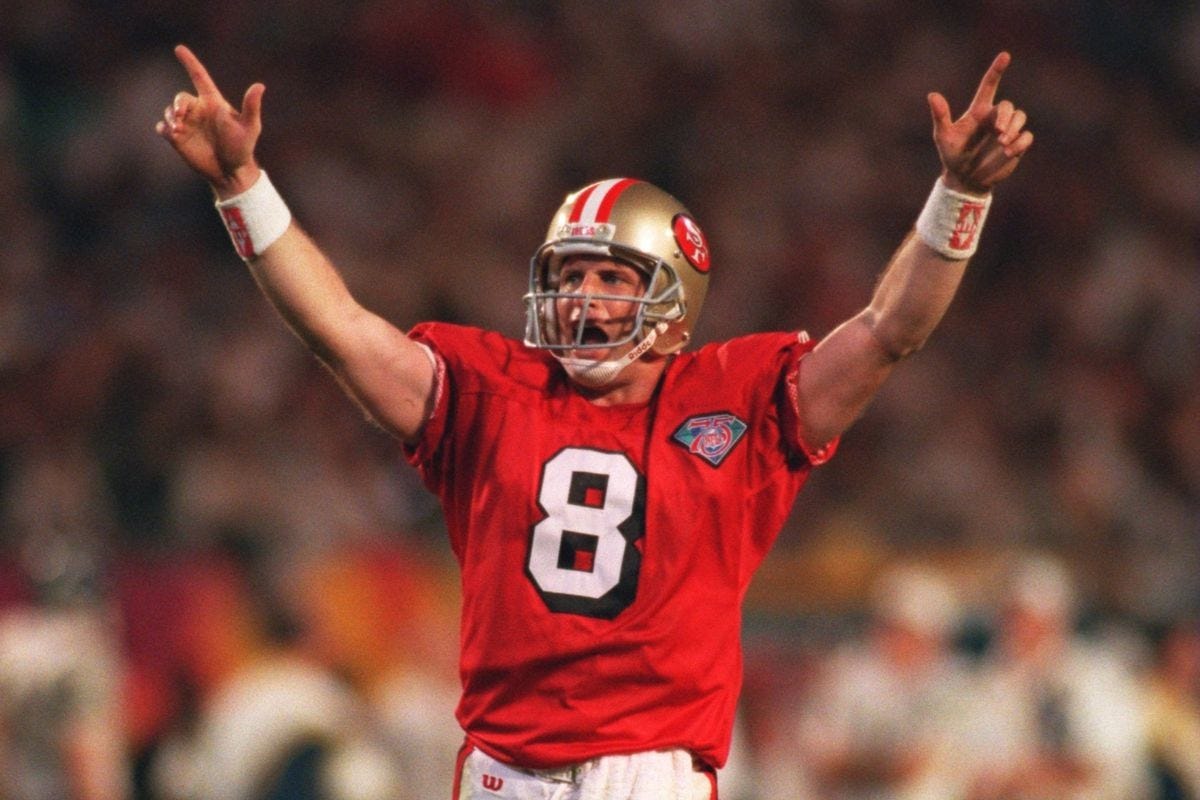
You should have a dream, but dreams are very low probability by definition. You should also have a plan. Have a dream and a plan. If a dream is less than 1% chance of accomplishing it, a plan is greater than 80% chance of accomplishing it.
-Steve Young’s dad
Good advice from Steve Young’s dad. Steve dreamed of being an NFL player, but he also had a backup plan to be a lawyer if that fell through. He actually went to law school while he was in the NFL.
-
Stories You Can Tell
Life moves quickly. Years can slip by unnoticed. Unless you are consciously pushing yourself, you may find with regret that you have squandered some of the best years of your life.
I try to imagine myself at 80, hanging out with my grandkids. What stories will I tell? What life did I live? Imagining that makes me want to take advantage of the time I have now as a younger man to live the life that’s worth telling in the future.
A slightly different idea in the same vein: I have a recurring reminder on my calendar: Goal setting for what it will make of you to achieve it. Set your goals big so the journey improves
Don’t let the years go by in unremarkable routine. Do crazy things. Take risks. Have fun. Make memories. Create stories. Life your life so you have great stories that you’re proud of in the end.
Here are some good quotes capturing this idea:
“The memories of a man in his old age; Are the deeds of a man in his prime.” – Roger Waters, Pink Floyd
“If you would not be forgotten as soon as you are dead, either write something worth reading or do things worth writing.” – Benjamin Franklin
-

Go without…
“Go without and see what you really need.” This is a stoic philosophy of “voluntary hardship” nicely summarized. Too often we get used to living a certain way and develop a dependence on things in our lives. Many of the things in your life you may not actually need. After all, what do you really need to live a good life? Not much if you pair it all down to the basics – safety, shelter, food, health, and family. What else is there?
You can simplify your life and understand your true needs by going without something to see if you really need it. This especially applies to material things, but it can also be routines or people in your life. If after a brief experiment you find that you don’t need something then you can eliminate it from your life.
-

What would you say?
Imagine you’re laying in your deathbed at 90 years old and your 30-year-old self is standing there talking to you. What would you say? -

What’s the worst that can happen?
This is a great thing to ask yourself when you’re a little nervous to move forward with something.
Thinking about asking a guy/girl on a date, but scared to ask? What’s the worst that can happen? He/she says no… That’s not too bad.
Want to start a business but can’t take the leap? What’s the worst that can happen? It doesn’t work out and you have to go back to your job (never burn bridges)….
You will often find that the answer isn’t that scary when you ask yourself “What’s the worst that can happen?” Think about the downside and you’ll see it probably isn’t that bad.
Conversely, you can also ask “What’s the best that can happen?” Think about the upside. Usually, you’ll find that the upside dramatically outweighs the downside. Yes, asking that guy/girl out may mean you get shot down. But it might also lead to your first date with your future spouse. Little downside, huge upside. Go for it!
Hopefully this helps you push forward and do the things that you really want to do in your life.
-

The One Thing They Can’t Take
You can be a professional athlete and get one injury and lose everything.
You can have millions of dollars and get robbed and lose everything.
The only thing people can’t take from you with your mind and your experience. That is the true foundation upon which everything is built. If you have a strong foundation and lose everything, you can always rebuild.
-

Say “Yes”
There’s a funny movie with Jim Carrey where he has to say “Yes” to everything for a month. He did this as an experiment because he was always saying no to everyone and living a generally miserable life. While saying “no” does not mean you will be miserable, it also cuts you off to a lot of excitement in life. I can’t remember a single exciting thing that happened in my life by saying “no” and sitting home on the couch. All of my best memories are from saying “yes.” This can be something as simple as a night out with friends that takes a wild turn or an around-the-world trip. It all starts with “Yes!”
With that said, you have to be careful what you commit to and it’s way too easy to get overcommitted on a million things and you don’t have time to breathe. This is also critical, and the art and science of saying Yes or No is something we can explore together later…